
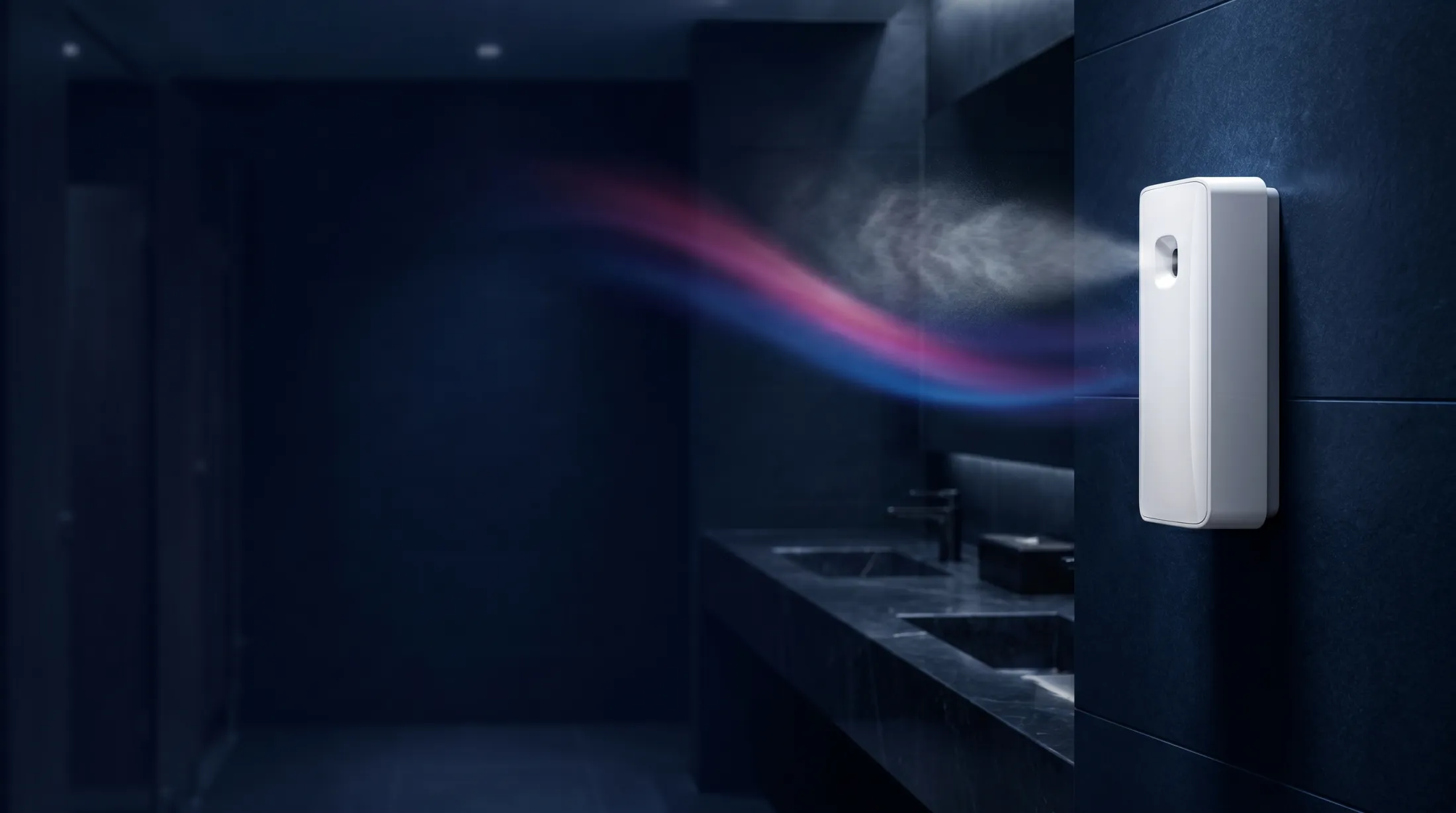
Commercial air freshening works by introducing fragrance and odour-neutralising compounds into the air at a controlled rate, either masking malodour molecules or reacting with them chemically. The most effective systems release fragrance continuously rather than in timed bursts, which keeps the scent level consistent and avoids the peaks and gaps users notice.
That is the short answer. The longer one is more interesting, because most washroom odour problems are not really fragrance problems at all.
Why Do Commercial Washrooms Smell in the First Place?
Washrooms smell because bacteria break down organic residue, not because the air itself has gone stale. Urine, faecal matter, skin cells, soap scum, and moisture provide everything bacteria need. As they metabolise that residue, they release volatile compounds that our noses are extremely good at detecting, often at concentrations of a few parts per billion.
The main culprits are well documented:
- Ammonia — produced when urease-producing bacteria convert urea in urine into ammonia and carbon dioxide. This is the sharp, acrid smell most people associate with urinals.
- Hydrogen sulphide and mercaptans — sulphur compounds from anaerobic bacterial activity, typically in drains, traps, and waste pipework. Detectable at vanishingly small concentrations.
- Indole and skatole — nitrogen compounds from the breakdown of faecal matter.
- Short-chain fatty acids — butyric and isovaleric acid, responsible for sour, rancid notes.
This matters practically. If the odour source is uric scale in a urinal trap or bacterial growth in a floor drain, no amount of fragrance will fix it — the bacteria keep producing volatiles for as long as the residue is there. Fragrance is the finishing touch on a clean washroom, not a substitute for one, which is why odour control starts with waste and sanitation before anyone talks about scent.
What Is the Difference Between Masking and Odour Neutralisation?
Masking covers a malodour with a stronger, more pleasant smell. Neutralisation changes the malodour molecule itself, or blocks the nose’s ability to perceive it, so the unpleasant smell is genuinely reduced rather than layered over.
Masking is the oldest approach and the one most cheap aerosols rely on. It works briefly, but the human nose is good at separating two competing smells. Anyone who has walked into a washroom and smelled both a floral fragrance and the odour underneath it has experienced the limits of masking.
Neutralisation works differently. Reactive molecules bind with or chemically alter odour compounds, and some fragrance formulations use counteractants that suppress the perception of specific malodours at receptor level. Modern professional air care systems combine both: a neutralising element that reduces the malodour, plus a fragrance that leaves a clean, pleasant impression.
A third approach removes the problem entirely. Air purification units use technologies such as UV-C, HEPA filtration, and photocatalytic oxidation to destroy airborne bacteria and the compounds they produce, rather than treating the smell after the fact. Many sites use purification in problem areas and fragrance everywhere else.
How Does Oxygen-Powered Fuel-Cell Diffusion Work?
Oxygen-powered systems use a small fuel cell to generate oxygen at a controlled, predictable rate. The gas pressurises a sealed chamber and gently displaces pure fragrance oil from a collapsible reservoir onto an emanator pad, where it evaporates naturally into the air. There is no propellant, no aerosol, and no spray.
The engineering advantage is consistency. A fuel cell produces gas at a steady rate for the life of the cartridge, so fragrance is delivered in a continuous, near-linear stream over 30, 60, or 90 days depending on how the unit is set. Compare that with a metered aerosol, which fires a concentrated burst every 7 to 15 minutes:
- Peaks and troughs — someone entering seconds after a spray gets an overwhelming hit; someone entering ten minutes later gets very little.
- Olfactory adaptation — the nose desensitises quickly to a strong, repeated stimulus, so intense bursts are perceived less over time than a steady low-level scent.
- Wasted fragrance — aerosol droplets settle on surfaces and are drawn into extract ventilation rather than staying in the breathing zone.
- Propellants and solvents — an aerosol is mostly not fragrance. Much of the can is carrier and propellant.
Our Oxy-Gen Powered Pro works on this principle and contains no CFCs, propellants, solvents, or alcohols, which is why it is specified so often in healthcare, education, and food-preparation environments. The Oxy-Gen Powered Supreme uses the same technology in a premium housing for front-of-house washrooms.
How Does Scent Affect the Perception of Cleanliness?
Scent shapes how people judge a space before they consciously assess it. Olfactory signals reach the limbic system, which handles emotion and memory, which is why smell produces such immediate, unfiltered reactions. Research into ambient scent in business settings has repeatedly found that a pleasant, congruent fragrance improves how visitors rate an environment and how long they spend in it.
The practical implication for facilities managers is that a washroom can be scrupulously clean and still be judged as dirty if it smells wrong.
Fragrance itself is built in three layers:
- Top notes — light, volatile molecules such as citrus and herbal notes. They evaporate fastest and give the first impression of freshness.
- Heart notes — floral, fruit, and spice notes that form the body of the fragrance.
- Base notes — heavier musk, wood, and vanilla molecules that evaporate slowly and give the scent longevity.
Citrus and clean linen notes are strongly associated with cleanliness in Western markets, which is why they dominate washroom fragrance ranges. Warmer floral and vanilla notes suit care homes and hospitality, where the goal is comfort rather than a clinical impression. Matching the fragrance to the setting matters more than the strength of it.
Why Does Low-VOC Matter Indoors?
Volatile organic compounds are carbon-based chemicals that evaporate readily at room temperature, and they matter indoors because concentrations build up in enclosed, poorly ventilated spaces. Washrooms are exactly that: small, warm, humid, and frequently occupied.
Fragrance oils are themselves VOCs, so the question is not whether an air care system emits any, but how much, and what else comes with it. Traditional aerosols add propellants, solvents, and alcohols to the air alongside the fragrance, and these make up the bulk of what is released. Systems that dispense pure fragrance oil with no carrier chemicals put far less total volatile load into the room to achieve the same perceived scent level.
This has become a genuine specification issue. Schools, nurseries, healthcare sites, and food-preparation areas increasingly ask for aerosol-free, solvent-free air care as standard, and indoor air quality is now a routine line in tender documents. A low-VOC system answers those questions without compromising on fragrance.
Getting the Balance Right in Your Washrooms
Good washroom air care is a sequence, not a single product. Deal with the odour source through proper cleaning, waste removal, and urinal sanitisation; add purification where airborne bacteria are the problem; then use a well-matched, consistently delivered fragrance to finish the job.
We supply, install, and maintain the full range of commercial air fresheners, including oxygen-powered units, with fragrance refills, battery replacements, and maintenance all included in the service. If you would like a recommendation based on your actual washrooms rather than a catalogue, book a free site survey or call us on 0800 389 8124 and we will assess the odour source before we suggest a scent.